
Trine 6: A Closer Look at Classic and Freestyle Puzzle Modes
Hello, adventurers!
One of the biggest pieces of feedback from our first private playtest concerned the puzzles in Trine 6: Together in Time and the heroes you use to solve them. Players wanted more opportunities to put each hero’s unique abilities to work, and more of the inventive puzzle solving they’ve enjoyed in previous Trine adventures.
That feedback helped shape one of the biggest changes we’ve been working on: Classic and Freestyle Puzzle Modes. Today, we’d like to show you how they work, what makes them different, and how you can make the adventure your own.
The journey so far
One of our primary goals for this new entry has been to make Trine 6 the most approachable game in the series. We want more players to feel comfortable picking up a controller, joining their friends, and enjoying a Trine adventure together. Part of that meant rethinking puzzles and co-op so that everyone could get involved and contribute along the way.
When we put that approach into players’ hands during our first private playtest, we learned that some of those changes came at a cost. For some longtime fans, puzzles felt less satisfying, and hero abilities felt less distinctive than in previous games. For those players, choosing the right hero and finding clever ways to use their abilities was a big part of what they loved about Trine, and our new approach had lost some of that appeal.
We still believe in making Trine 6 more approachable, and your feedback helped us understand what mattered most to longtime fans. Rather than change the gameplay across the board, we decided to create two distinct experiences, each with its own puzzle design.
Freestyle Puzzle Mode carries forward our goal of welcoming more players, with a more active approach to puzzles, freedom of hero choice, and co-op that keeps everyone involved.
Classic Puzzle Mode puts a greater focus on hero abilities and strategic puzzle solving, offering an experience more akin to previous Trine games.
Both are available throughout the entire adventure. We hope you’ll give each a try, whether you switch things up along the way or return for another playthrough with a fresh set of puzzles.
Your adventure, your settings
When you start a new game, you’ll choose between two curated experiences to help you get going.
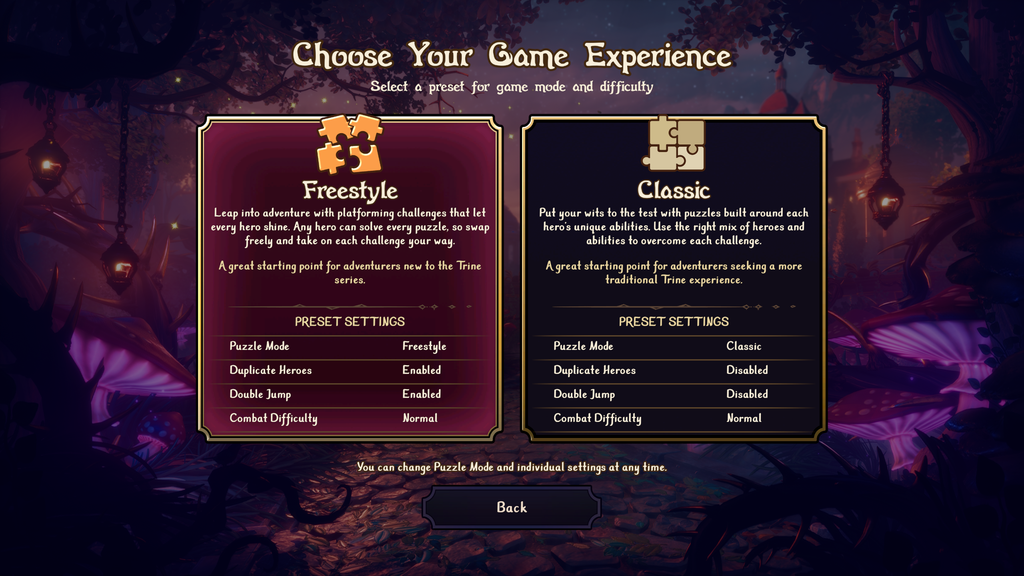
These give you a starting set of options, including your Puzzle Mode. Once you’re in the game, you can also adjust individual settings such as combat difficulty, whether players can choose the same hero in multiplayer, and whether double jump is enabled.
You can mix and match these settings and change them at any time during the game, including switching between Classic and Freestyle Puzzle Modes. Try out both, see what you and your friends enjoy, and adjust things as you go.
Let’s take a closer look at each mode.
Freestyle Puzzle Mode
Freestyle puts movement, timing, and freedom of hero choice at the heart of its puzzles. Every hero has a way to tackle every puzzle, so you’re free to choose based on how you like to move, fight, and play. You can stick with a favorite or swap between heroes whenever you fancy a change.
For co-op, we took inspiration from games like It Takes Two and Split Fiction, where everyone takes an active part in the adventure. Each player makes their way through the platforming sections, while puzzles give you opportunities to work together by operating consoles, timing your actions, and setting things up for each other. The goal is to give everyone a part to play, rather than having one player do all the work while the others watch.
We think Freestyle is a great place for adventurers new to Trine or groups with mixed experience levels to start, especially if you enjoy an active adventure where everyone gets involved.
Here, Pontius and Zoya each pull a lever to let the bubbles pass through. Once the bubbles are clear, popping them lowers the drawbridge.
Zoya handles that part with her bow in this example, but another hero could do the job too. Pontius could throw his hammer, or Moira could kick a ball. Working together gets the bridge down, and you have the freedom to choose which heroes you use to do it.
Classic Puzzle Mode
Classic puts the heroes’ distinct abilities at the center of the puzzle. You’ll need to look at what’s in front of you, consider who can help, and work out how their abilities can get you where you need to go.
Playing solo, that often means swapping between heroes to put a plan into action. With friends, you can share those roles and use your abilities together. Depending on your group’s size and hero choices, some swapping may still be needed along the way.
Classic is designed to be played without double jump, though you can enable it if you’d like an extra boost.
If figuring out a clever solution with Trine’s cast of heroes is your favorite part of the adventure, this is a good place to start.
There’s quite a gap to cross here, and this solution calls for help from several heroes.
First, Amadeus conjures a box for Zoya to hang from using her rope. From there, she can shoot the brambles holding up the first platform, bringing the two platforms to the same height.
Next, Adrius places a spear to serve as an anchor point, and Amadeus conjures another box on the far platform. Zoya then connects the spear and box with her rope, making a bridge across.
A little magic, some careful aim, and a very useful spear!
That’s one way across. Classic puzzles leave room to experiment, and we’re looking forward to seeing what other solutions players discover.
Familiar surroundings, different puzzles
In most cases, the puzzle design changes substantially between modes. To show what that means, let’s look at the same locations in Freestyle and Classic.
Across the fire
A flaming pit below and spikes overhead make this a rather uninviting crossing.
In Freestyle, players use a console to release bubbles from a cauldron, then make their way across on the bubbles while avoiding the spikes above. Getting through takes careful movement and timing.
In Classic, the console is gone, and those spikes suddenly look much more useful. Amadeus can attach a conjured box to them, giving Zoya somewhere to secure her rope and swing across the pit.
The destination is the same, but each mode gives you a different problem to work through.
A little push
Here, a magical device needs to be spun around to open the way forward.
In Freestyle, a box is already attached to the device. Any hero can get it moving by applying enough force. In this example, Moira uses a series of jumps, kicks, and some clever ribbon work to turn it all the way around.
In Classic, you’ll need to put a few things in place first. Our favorite Master of the Boxes, Amadeus, conjures a box, and Zoya attaches it to the device with her rope. Amadeus can then move the box to turn the mechanism into position.
Both puzzles invite you to play with physics, with different tools and possibilities to work with in each mode.
We’d love to see your solutions
These are just a few examples of what we’ve been working on across Classic and Freestyle Puzzle Modes.
Experimentation has always been part of the fun of Trine. A puzzle might have several solutions, including some we never planned for, and discovering your own way through can be just as satisfying as the crossing itself. We’re excited to see what you and your friends come up with.
We also want to thank everyone who shared their thoughts during the first playtest. Your feedback helped us understand what you wanted more of, and our next playtest will help us find out how these changes feel in your hands.
Our second private playtest runs from October 27 to November 2, with both Classic and the updated Freestyle Puzzle Modes available to try. You can sign up here for a chance to take part.
Trine 6: Together in Time launches on March 4, 2027. We’ll have more to share as we get closer, and we look forward to hearing what you think!
— Frozenbyte and Cooldown Games

Previous post
« Trine 6 Private Playtesting Returns October 27!